
Teaching Philosphy
My teaching philosophy centers on fostering curiosity and empowering learners to become environmental stewards. I strive to create lessons that are not only informative but also engaging and accessible, whether I’m working with elementary school students, undergraduates, or community members. Hands-on, interdisciplinary approaches are central to my teaching, as they allow students to connect with environmental issues in meaningful ways.
I also believe that education extends beyond the classroom. My leadership of Sea Turtle Week reflects my commitment to global education and conservation. Creating lesson plans, contests, and other resources that are accessible worldwide has allowed me to reach a broad audience and contribute to fostering a global community of learners and conservation advocates. By sharing knowledge and tools, I hope to inspire people of all ages to take action and make a positive impact on our planet.
I offer virtual and in-person lessons in the NJ/PA area on environmental and STEM topics for grades K-College. Some topics include but are not limited to the biology of sea turtles, how to become a research scientist, plastic pollution & recycling, marine ecosystems, and weather systems, all of which are tailored to the appropriate grade level. I also create classroom resources through my Teachers Pay Teachers store, Seantist’s Classroom. If you are in me speaking to your class, please fill out this contact form. I can't wait to help inspire your students!
Elementary
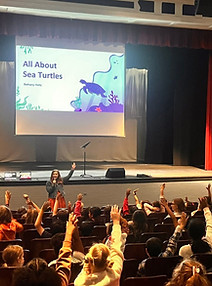
I have a passion for creating engaging, hands-on learning experiences for young students. As a LINKS Fellow at the Wagner Free Institute of Science, I led and co-taught science lessons for grades K-5, designing activities that sparked curiosity and excitement about STEM topics. I also helped launch an after-school STEM club to provide students with additional opportunities for creative and inquiry-based learning.
In 2024, I developed Sea Turtle Week lesson plans for grades K-12, which were downloaded 269 times worldwide. These lessons focus on sea turtle life cycles, habitats, and the challenges these animals face, blending engaging content with meaningful conservation themes. Knowing that these materials have reach classrooms from the U.S. to Indonesia is one of my proudest accomplishments, as they continue to inspire young learners to care for the environment.
Recently, I started creating educational resources for K–12 educators through my Teachers Pay Teachers store, Seantist’s Classroom. I have developed over 95 scaffolded marine biology and environmental science lessons, which have been downloaded by teachers in 37 states. Each resource is designed to make complex scientific concepts accessible and engaging, supporting educators in bringing the ocean and natural world into their classrooms with confidence.


College


My collegiate teaching experience began at Gettysburg College, where I served as a Peer Learning Associate in Earth System Science and Introduction to Photography, mentoring students in both scientific and creative disciplines.
Today, I teach as an Adjunct Professor at Kean University (Union and Toms River, NJ) and Saint Joseph’s University (Philadelphia, PA). At Kean, I design and deliver courses in Introduction to Environmental Science and upper-level classes in Principles of Soil Science and Conservation Biology. I provide detailed feedback on assignments and exams, maintain the course website through Canvas, and hold regular office hours to support student success and foster environmental literacy through interactive, experiential learning strategies. At Saint Joseph’s University, I teach Introduction to Environmental Science labs, where I emphasize safe and effective lab practices, encourage critical observation, and help students connect experimental results to broader environmental processes and challenges.
My work as a conservation researcher shapes my teaching. Through my fieldwork and experience with tools like GIS and bioacoustics, I bring practical applications into the classroom, helping students bridge theoretical concepts with real-world challenges. I aim to equip college students with the knowledge and skills they need to contribute meaningfully to environmental research and conservation.